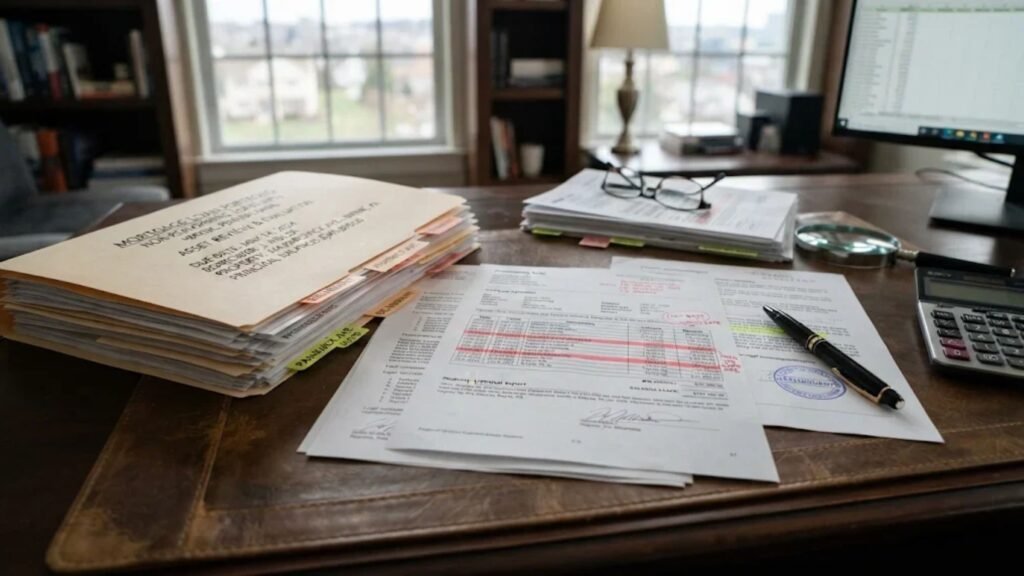
Before a non-performing loan buyer wires funds, you will be asked for five groups of documents: loan-level data, the collateral file, the servicing file, the signed transaction documents, and the transfer documents that hand the loan over. An offer can be made on less. A purchase cannot close on less.
This guide walks you through each group, explains what the buyer is checking, shows which gaps stop a closing and which only change the price, and ends with a closing day checklist you can use on a loan secured by property in or around Wayne, Pennsylvania.
One note on scope: if you are still at the pricing stage, start with our guide to the documents a note buyer needs before making an offer. This article picks up where that one stops, at the point where you have accepted a number and need to get to funding.
The short answer: five document groups in a closing file
A non-performing loan is a loan on which the borrower has stopped paying as agreed, usually for 90 days or more. When you sell one, the buyer is purchasing your right to collect the debt and your lien on the property. Every document in the file supports one of those two rights or tells the buyer what collecting will cost.
| Document group | What it includes | What it proves to the buyer |
|---|---|---|
| 1. Loan-level data | Loan tape or summary sheet: unpaid principal balance, rate, maturity, last payment date, property address, lien position | The loan is what the offer was priced on |
| 2. Collateral file | Original promissory note with endorsements and allonges, recorded mortgage, recorded assignments, title policy, modifications | The debt is enforceable and the lien is valid |
| 3. Servicing file | Full payment history, escrow and tax records, insurance, borrower correspondence, default notices, foreclosure or bankruptcy pleadings | What has happened since default and what recovery will cost |
| 4. Transaction documents | Confidentiality agreement, loan sale agreement, assignment of mortgage, allonge to the buyer, lost note affidavit if needed | You have the authority to sell and the transfer is legally complete |
| 5. Transfer documents | Servicing transfer notices, insurance and tax contact changes, attorney file transfer | The buyer can step into your position without a gap |
On our own acquisitions, we start due diligence from four items: the original note, the security instruments, current payment history, and any existing title or appraisal data for the collateral. Everything else in the table builds on those four.
What you need at each stage, from accepted offer to funding
The document request grows as the deal gets closer to money changing hands. Knowing the order helps you avoid pulling everything at once.
| Stage | Documents the buyer requires | Who usually prepares them |
|---|---|---|
| Offer accepted | Signed confidentiality agreement, loan tape, copies of note and mortgage | You provide; buyer signs the confidentiality agreement |
| Due diligence | Complete collateral file images, payment history, servicing notes, title and valuation data, litigation and bankruptcy filings | You or your servicer |
| Contract | Loan sale agreement with schedule of loans and any disclosed exceptions | Buyer or seller counsel, negotiated by both |
| Closing | Original note, executed allonge, executed assignment of mortgage in recordable form, lost note affidavit if required | You sign; buyer or its custodian receives originals |
| Post-closing | Servicing transfer notices, recorded assignment, remaining original documents | Both sides, on the schedule in the agreement |
A clean file moves through these stages quickly. A file with gaps does not, and the difference can be weeks. For realistic ranges, see how long a non-performing mortgage note sale takes in Wayne, PA.
Loan sale documentation: the agreement that controls the deal
Loan sale documentation is the set of contracts that governs the transfer. The central document is the loan sale agreement, sometimes called a mortgage loan purchase agreement. Read it as a list of promises about your file, because that is how the buyer reads it.
Expect the agreement to cover:
- Purchase price and cut-off date. The date that decides who keeps payments, escrow balances and advances.
- Representations and warranties. Your statements that you own the loan, that the balance is accurate, and that the documents delivered are genuine.
- Disclosed exceptions. A schedule listing known defects, such as a missing assignment. A disclosed defect gets priced. An undisclosed one becomes a claim against you later.
- Remedies. What happens if a representation proves wrong, often a cure period followed by a repurchase or price adjustment.
- Closing deliverables. The exact originals you must hand over and when.
Many distressed sales are written on an as-is basis with limited representations. Limited does not mean none. Ownership and authority to sell are almost always warranted, so the documents proving them need to be in the file before you sign.
Mortgage assignment records: moving the lien to the buyer
Two things transfer when a mortgage loan is sold, and each has its own paper trail. The debt moves by endorsing the promissory note, either on the note itself or on an allonge, which is a separate signed page attached to it. The lien moves by an assignment of mortgage, which is recorded in the county land records. Mortgage assignment records are the recorded history of every time that lien has changed hands.
A buyer requires both trails to be complete and to match. If the note was endorsed from Lender A to Lender B to you, the recorded assignments should show the same path. A break in either one is the most common reason a closing stalls. We cover how buyers test this in our article on chain of title verification in a note acquisition.
Why this matters more in Pennsylvania
Pennsylvania is a judicial foreclosure state, which means a mortgage is foreclosed through a court action. The foreclosing party generally has to identify the mortgage and its assignments in the complaint, including where they are recorded. A buyer who cannot do that cannot use the main enforcement tool, so an unrecorded or missing assignment is treated as a real defect, not a formality.
Which county holds the records for a Wayne property
Wayne is not a single municipality. It spans three townships in three counties, and the assignment has to be recorded in the county where the property sits:
- Radnor Township: Delaware County Recorder of Deeds
- Tredyffrin Township: Chester County Recorder of Deeds
- Upper Merion Township: Montgomery County Recorder of Deeds
Check the property’s tax parcel, not its mailing address, before you order a records search. A Wayne mailing address alone will not tell you which recorder to use.
If MERS appears in the chain
If the mortgage names Mortgage Electronic Registration Systems (MERS) as nominee, transfers between MERS members may not appear in county records. The buyer will want the MERS identification number and an assignment out of MERS, or a transfer on the MERS system, as part of the closing package.
Distressed debt paperwork that only a defaulted loan has

A performing loan sells on its collateral file and payment record. A non-performing loan carries extra paper created by the default itself, and the buyer requires all of it because each item changes what they can do next.
- Default and pre-foreclosure notices. Copies of every notice sent, with dates and proof of mailing. Pennsylvania has specific notice requirements for certain residential mortgages, and a buyer needs to know whether they were met or must be redone.
- Foreclosure pleadings. The complaint, docket, any answer or counterclaim, and your foreclosure attorney’s contact details.
- Bankruptcy filings. Case number, chapter, proof of claim, and any plan or stay relief order.
- Forbearance, modification or repayment agreements. Signed copies, including any that failed.
- Property tax, municipal lien and insurance status. Unpaid taxes can take priority over the mortgage, so buyers verify them directly.
- Property information. Occupancy status, inspection reports, and any broker price opinion or appraisal you already hold.
Signatures deserve their own pass. An unsigned modification or an allonge missing an authorized signer can undo an otherwise complete file. Our guide on how buyers check loan documents for missing signatures shows where these problems usually hide.
Which gaps stop a closing and which only change the price
Not every missing document is equal. A useful way to sort them is the day-after-funding test: if the buyer owned this loan tomorrow, could they prove they own the debt and the lien, and enforce both? If a gap makes the answer no, it blocks the closing until it is fixed or specifically contracted around. If the answer is still yes but collection becomes slower or costlier, the gap is a pricing item.
| Gap in the file | Usual effect | Typical way forward |
|---|---|---|
| Original note cannot be located | Closing blocker | Lost note affidavit with indemnity, if the buyer accepts one; expect a price adjustment |
| Break in the assignment chain | Closing blocker | Obtain and record the missing assignment, or a corrective assignment, before or at closing |
| Endorsements and assignments do not match | Closing blocker | Corrective allonge or assignment from the prior holder |
| Unsigned or unrecorded modification | Often a blocker | Confirm which terms control; re-execute if the borrower cooperates |
| Incomplete payment history | Price adjustment | Reconstruct from servicing system records; buyer discounts for uncertainty |
| No title policy on hand | Price adjustment | Buyer orders a title search at its own or shared cost |
| No recent valuation | Usually neither | Buyer obtains its own valuation |
Outcomes vary by buyer and by loan. The table reflects common practice, not a rule, and your counsel should confirm how a specific defect is handled in your agreement.
Closing-day checklist
Use this list in the week before funding. Each line is something the buyer will require in hand or in escrow.
- Loan sale agreement signed by an authorized officer, with the loan schedule and exceptions attached.
- Evidence of signing authority, such as a resolution or incumbency certificate, if the agreement calls for it.
- Original promissory note, with all prior endorsements and allonges attached.
- New allonge or endorsement to the buyer, signed and dated.
- Assignment of mortgage to the buyer, signed, notarized and in recordable form for the correct county.
- Lost note affidavit, only if agreed in advance.
- Original or certified copy of the recorded mortgage and all prior recorded assignments.
- Title policy, modifications and other collateral file originals.
- Final payment history and payoff figures as of the cut-off date.
- Servicing file transfer and contact details for foreclosure or bankruptcy counsel.
After the purchase: paperwork that follows the loan
Your document obligations do not end at funding. For residential mortgage loans, federal rules generally require the old and new servicers to notify the borrower of a servicing transfer, and the new owner to notify the borrower of the change in ownership, within set timeframes. The loan sale agreement should state who sends what and when.
You should also expect to forward any borrower payments or mail received after the cut-off date, cooperate with a substitution of counsel in any pending court case, and deliver trailing documents such as a recorded assignment once the county returns it.
Frequently asked questions
Who prepares the assignment of mortgage?
Practice varies. Often the buyer or its counsel drafts the assignment and you sign it, because the buyer is the party who needs it to be recordable. The loan sale agreement should say who drafts, who records and who pays the recording fee.
Can I sell a loan that is already in foreclosure?
Yes. A pending foreclosure does not prevent a sale. The buyer will require the pleadings and docket, and after closing will typically ask the court to substitute it as plaintiff. A case that is further along can be worth more to a buyer, provided the filings are sound.
Do I need a new appraisal before selling?
Usually not. Send whatever title or valuation data you already have. A buyer normally forms its own view of the collateral and will order what it needs.
Your next step
Pull the original note and the recorded assignments first, and compare the two chains line by line. That single check tells you whether your loan can close on a normal timeline or needs curative work before you go to contract.
When you know what you have, request a confidential offer on your non-performing loan. We typically express a firm level of interest within 48 to 72 hours of receiving portfolio data, and we will tell you early which documents we still need to get to closing.
This article is general information, not legal advice. Have your counsel review any loan sale agreement and confirm Pennsylvania and federal requirements for your specific loan.