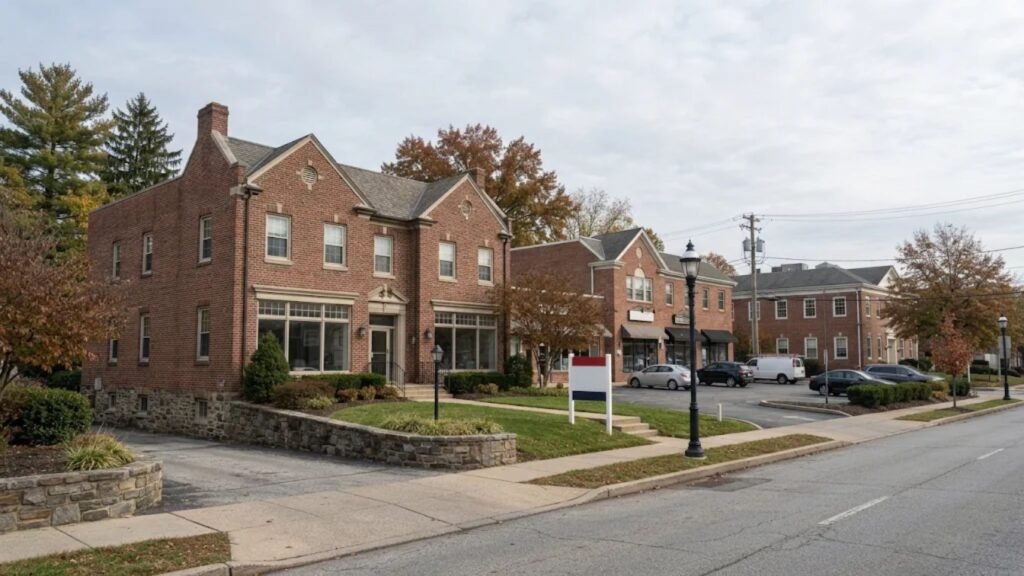
If you hold a non-performing mortgage note in Wayne or elsewhere on the Main Line, the offer a buyer makes comes from one calculation: how much cash the loan will realistically produce, how long that will take, and what it will cost to collect, discounted for time and risk. The unpaid balance is only the starting reference.
Non-performing loan buyers reach that number by checking five things (collateral, lien position, borrower history, legal status and the loan file) and then running those facts through Pennsylvania’s judicial foreclosure timeline. This guide walks you through each check, shows a worked pricing example for a hypothetical Wayne-area loan, and lists what you can send to get a firmer, faster offer on your distressed mortgage notes.
What a buyer is really pricing when you sell a distressed note
When you sell a distressed note, you are not selling a balance sheet entry. You are selling the right to collect on the promissory note and enforce the mortgage. The buyer pays you today for cash that arrives later, through a payoff, a workout, a negotiated exit or a sheriff sale. Four terms anchor every conversation about price:
- Non-performing loan (NPL): a loan on which the borrower has missed scheduled payments for a defined period, commonly 90 days or more.
- Distressed mortgage note: a promissory note secured by real estate that is in default or at clear risk of default.
- Unpaid principal balance (UPB): the principal still owed, before arrears, default interest and fees.
- Mortgage note valuation: the estimate of what a note is worth today, based on expected net recoveries discounted for time and risk.
When we review a loan, we start from the four factors we base every offer on: the real collateral value and location, the borrower’s history and performance, the legal status and lien position, and the overall recovery potential and condition of the asset. Most experienced buyers use some version of these lenses. What differs from buyer to buyer is how each one converts them into time, cost and probability.
The five checks buyers run on a Wayne-area distressed note
1. Collateral value and location
Collateral sets the ceiling on what you can recover. A buyer wants today’s as-is value, not the appraisal from origination, so expect a request for a recent broker price opinion, an appraisal or at least interior photos. Condition matters as much as comparable sales: deferred maintenance, vacancy and code problems all lower what the property will bring at resale.
Location in Wayne carries a detail many sellers overlook. Wayne is not a municipality of its own; it spans parts of Radnor Township in Delaware County, Tredyffrin Township in Chester County and Upper Merion Township in Montgomery County. The county decides which Court of Common Pleas hears a foreclosure, which sheriff runs the sale and which local foreclosure programs apply, so a buyer confirms the county before modeling any timeline.
2. Lien position and title
A first-lien note on a property with clean title prices very differently from a second lien or a loan clouded by other claims. Buyers look for unpaid real estate taxes, municipal and utility liens, judgments and mechanics’ liens, because some of them must be cleared before the property can be sold. In our Philadelphia warehouse case study, a matured first mortgage came with delinquent taxes and a township lien on a fire-damaged building; resolving that lien was part of the path to a full payoff through refinance.
3. Borrower history and occupancy
Payment history tells a buyer whether the borrower is likely to cure, sell or cooperate. Buyers look at the date of the last payment, any partial payments, prior modifications or forbearance, hardship letters, and whether anyone at your institution is still in contact with the borrower. Occupancy matters too: an owner-occupied home brings Pennsylvania’s homeowner protections into play, while an investor property or commercial building follows a different path.
4. Legal status and enforcement stage
Buyers need to know exactly where the loan sits: no notices sent, notices sent, complaint filed, judgment entered, sheriff sale scheduled, or stayed by a bankruptcy filing. Each stage moves the expected cash closer or further away. A bankruptcy filing, for example, halts collection activity under the automatic stay and can push recovery out by months or longer. Our article on how legal risks are priced into non-performing debt valuation covers bankruptcy chapters, title defects and judicial timelines in more depth.
5. The loan file and chain of title
A note is worth only what you can prove you own and can enforce. Buyers check the original note and every endorsement or allonge, each recorded assignment of mortgage, the mortgage itself and any modification agreements. A missing assignment or a lost note does not always end a deal, but it adds curative legal work and time, and buyers price that in. For a complete list of fields and documents, see the loan level data buyers request for a professional valuation.
How Pennsylvania’s foreclosure rules change the numbers
Pennsylvania is a judicial foreclosure state. A lender must file a complaint in the county Court of Common Pleas, obtain a judgment and then have the county sheriff sell the property. That structure, together with the state’s pre-foreclosure notice rules, sets the minimum time a buyer must wait before collateral can turn into cash.
| Rule or stage | What it requires | How a buyer uses it |
|---|---|---|
| Act 91 notice (HEMAP) | For covered owner-occupied homes, the notice tells the homeowner about the Homeowner’s Emergency Mortgage Assistance Program. The homeowner has 33 days to meet with an approved counseling agency, and the lender may not act for 30 days after the notice. If an application is filed, the Pennsylvania Housing Finance Agency has 60 days to decide. | Adds at least a month, often more, before a complaint can be filed. A buyer checks whether a compliant notice was sent and when. |
| Act 6 notice | A notice of intention to foreclose must be sent at least 30 days before the foreclosure complaint is filed on a covered residential mortgage. | Another fixed waiting period. A defective notice can force the clock to restart. |
| Diversion or conciliation programs | Several Pennsylvania judicial districts, including Delaware County, have operated court programs that bring owner-occupants and lenders together before a sheriff sale. | Adds conference dates to the schedule, but can also produce a workout that pays more than a sale. |
| Sheriff sale | The sale is advertised once a week for three weeks and runs on the county sheriff’s calendar. | Ties the final step to each county’s sale schedule. |
| Commercial loans | Act 91 and Act 6 protect residential borrowers. Commercial notes still go through the courts but may carry different remedies under the loan documents. | Buyers have Pennsylvania counsel review the commercial loan documents before pricing. |
The practical lesson: if notices were never sent, or were sent with errors, a buyer generally models the timeline as if the clock has not started. Sending compliant notices before you market a note, or at least documenting exactly what was sent and when, removes one of the largest timing discounts. This section is general information, not legal advice; your Pennsylvania counsel should confirm which notices apply to a specific loan.
A worked example: pricing a hypothetical Wayne area note
Numbers make this concrete. The loan below is hypothetical, and the assumptions are illustrative. They are not our pricing or any buyer’s standard rate.
- Owner-occupied single-family home, first lien, clean title apart from current-year taxes
- Unpaid principal balance: $440,000
- Total owed, including arrears and fees: $480,000
- As-is value from a recent broker price opinion: $520,000
- Buyer’s required return (discount rate): 15% per year
- Due diligence cost: $3,500
A buyer models each realistic way the loan could resolve, then weights each path by its probability:
| Resolution path | Probability | Net cash | Months to cash | Present value at 15% | Weighted value |
|---|---|---|---|---|---|
| Borrower reinstates, refinances or pays off | 30% | $480,000 | 9 | $432,233 | $129,670 |
| Deed in lieu or short sale | 30% | $463,600 | 12 | $403,130 | $120,939 |
| Foreclosure, sheriff sale and resale | 40% | $433,600 | 24 | $327,864 | $131,146 |
| Total | 100% | $381,755 |
Net cash on the deed-in-lieu path assumes a resale at the $520,000 value less 7% for commissions, transfer taxes and concessions, minus $12,000 of legal and title costs and $8,000 of relocation and holding costs. The foreclosure path uses the same resale math, minus $12,000 of initial legal costs, $20,000 of additional court and holding costs, and $18,000 for taxes, insurance and repairs.
Bid ceiling = sum of (probability × net cash ÷ (1 + discount rate) ^ years to cash) − due diligence cost
Here that comes to $381,755 − $3,500, or roughly $378,000: about 86% of the unpaid balance and about 73% of the collateral value. A loan with thin equity, a second lien or a title problem would price far lower, because the foreclosure path would recover less and carry more risk.
What moves the number most
- Time on the foreclosure path. If a contested case or a bankruptcy stretches that path from 24 to 36 months, the bid ceiling falls by about $17,100, with nothing else changed.
- The mix of outcomes. If the payoff and negotiated-exit paths drop to 20% each and foreclosure rises to 60%, the ceiling falls by about $18,000.
- Collateral value. Lost resale value flows almost straight through the negotiated-exit and foreclosure paths, which carry 70% of the weight in this example.
You can test your own figures (balance, collateral value, foreclosure and restructuring costs, discount rate and success probabilities) in our NPL Resolution Options Calculator, which compares restructuring, foreclosure and a private note sale side by side.
Why two non performing loan buyers can price the same note differently

If you collect more than one bid, the spread can be wide even when every buyer sees the same file. The gap usually comes from four places:
- Required return. A buyer funded with more expensive capital uses a higher discount rate, which lowers every present value in the table above.
- Exit options. A buyer who can only foreclose must weight the slowest path heavily. A buyer with workout and restructuring experience can put more weight on faster, higher-value outcomes.
- Real estate capability. Buyers who can manage, repair and resell property themselves face lower cost and less uncertainty on the foreclosure path.
- Deal size and process. Bulk portfolio bids often apply a blended discount, while a single-note review can price each loan on its own facts.
This is where our background works in your favor. Our principals own a residential brokerage agency, own and manage residential and commercial real estate in several property classes, and have long experience with loan originations and workouts. That combination lets us weigh workout and restructuring outcomes alongside foreclosure, rather than pricing every loan as if it will end at a sheriff sale.
How to prepare your note for a faster, firmer offer
Buyers price uncertainty as risk, so the most effective way to improve an offer is to remove unknowns. Before you send a loan out for review, gather:
- A copy of the original note with every endorsement or allonge, plus the mortgage and all recorded assignments.
- Any modification, forbearance or settlement agreements.
- A current payment history, with the date and amount of the last payment and a payoff figure.
- Servicing and collection notes, including the most recent borrower contact.
- Copies of any Act 91 and Act 6 notices with proof of mailing, for residential loans.
- Title information: a recent title report, tax status and any municipal lien search.
- The latest appraisal or broker price opinion, the occupancy status and property photos.
- Docket numbers for any foreclosure or other litigation, and any bankruptcy filings.
To start due diligence, we need the core items: the original note, the security instruments, the current payment history and any existing title or appraisal data. We typically express a firm level of interest within 48 to 72 hours of receiving and reviewing that information. If you already know about a problem, such as a missing assignment or a tax lien, disclose it up front. A known problem gets a specific price adjustment; an unknown one gets priced as the worst case.
Frequently asked questions
Will the borrower know the note was sold?
Yes. For consumer mortgage loans, federal law requires the new owner to notify the borrower in writing within 30 days after the transfer, and a change of servicer brings its own notices. A discreet buyer can still keep the handover professional and limit disruption to the borrower relationship.
Do you need the borrower’s cooperation to sell a non-performing note?
No. The sale is between you and the buyer. The borrower’s obligations under the note and mortgage stay the same, and the buyer steps into your position.
Can commercial distressed notes be sold the same way?
Yes. We buy non-performing residential and commercial mortgage notes. Commercial loans follow a different legal path in Pennsylvania, so the loan documents, leases and property income carry more weight in the review.
Is the unpaid balance the starting point for the offer?
It is a reference point, not the price. The offer follows the expected net recovery, so a well-secured loan can price close to its balance while a loan with title defects or little equity prices at a steep discount.
Your next step
If you hold a distressed mortgage note in Wayne, elsewhere on the Main Line or anywhere in greater Philadelphia, start by assembling the file checklist above and running your assumptions through the calculator. Then send us the loan details or call Brett or Gabe at 610-550-8375. We respond to every inquiry within 24 hours, and every conversation is kept confidential.